







What a mini split tune-up covers in Louisiana

Step 1 of 3: Equipment

What does a mini split tune-up include in Louisiana?

You run your mini split almost year round here, cooling through the muggy months and heating through the winter since electric heat is what most homes use. Before summer sets in, or before the first cold snap, you want to know someone is going to check it over properly and not just wipe down a filter and call it done.

It covers the filters, the coils, the blower wheel, the condensate drain and the refrigerant charge.

A technician cleans or replaces the filters, washes the indoor and outdoor coils, and checks the blower wheel for dust buildup, since all three affect how much moisture your system pulls out of the air. In Louisiana humidity, a dirty coil loses cooling capacity fast and runs longer to do the same job. The condensate drain gets cleared, because a clogged one backs up and drips inside the house. The refrigerant charge gets checked against what the unit calls for, since a low charge makes the compressor work harder and shortens its life. Electrical connections and the outdoor unit's fan motor get a check too, since both sit outside and take a beating from Louisiana heat and storms all year.

A man in a blue sweatshirt reclines with closed eyes in a brown leather armchair in a living room with a bookshelf, houseplant, sofa, window, and a side table holding newspapers and a dark mug.
A bearded man in a gray pullover reclines with closed eyes on a brown leather sofa in a sunlit room with a window, framed picture, potted plant, and a wooden cabinet holding papers and a dark mug.
A man in a gray sweater leans back with closed eyes in a brown leather armchair beside a wooden side table holding a dark mug and a folded newspaper, with bookshelves and a window seat behind him.
A man in a green sweater reclines in an armchair with his eyes closed and a slight smile, beside a window with plants, a small table holding a mug and folded newspaper, and bookshelves behind him.

Tune-Up Now or Wait It Out

Tune-up now

  • A technician cleans the indoor coil and blower wheel so the unit can move the air it was built to move.
  • The outdoor coil gets washed free of pollen, grass clippings and the film that builds up over a Louisiana summer.
  • The condensate drain gets cleared, which matters here since a clogged drain means water finding its way into your wall or ceiling.
  • Refrigerant charge gets checked against what the system calls for, because a low charge makes it run longer to do the same job.
  • Electrical connections and the capacitor get tested while the unit is apart, before a loose wire or a weak part becomes a no-cool call.
  • You get a written read on where the system stands, so you know what if anything needs attention before the next bill arrives.

No tune-up

  • A dirty outdoor coil has to work harder to shed heat, and that shows up as a higher electric bill before anything actually breaks.
  • A clogged drain line backs up quietly, and the first sign is often water damage rather than a warning.
  • A capacitor that's starting to go usually keeps working until the day it does not, often on the hottest afternoon of the year.
  • Dust and grime on the indoor coil cut how much the unit cools or heats for the same amount of running time.
  • Small issues go unseen until the unit is already struggling, which tends to mean a repair call instead of a planned one.
  • You lose the chance to know where things stand before summer or winter puts real demand on the system.
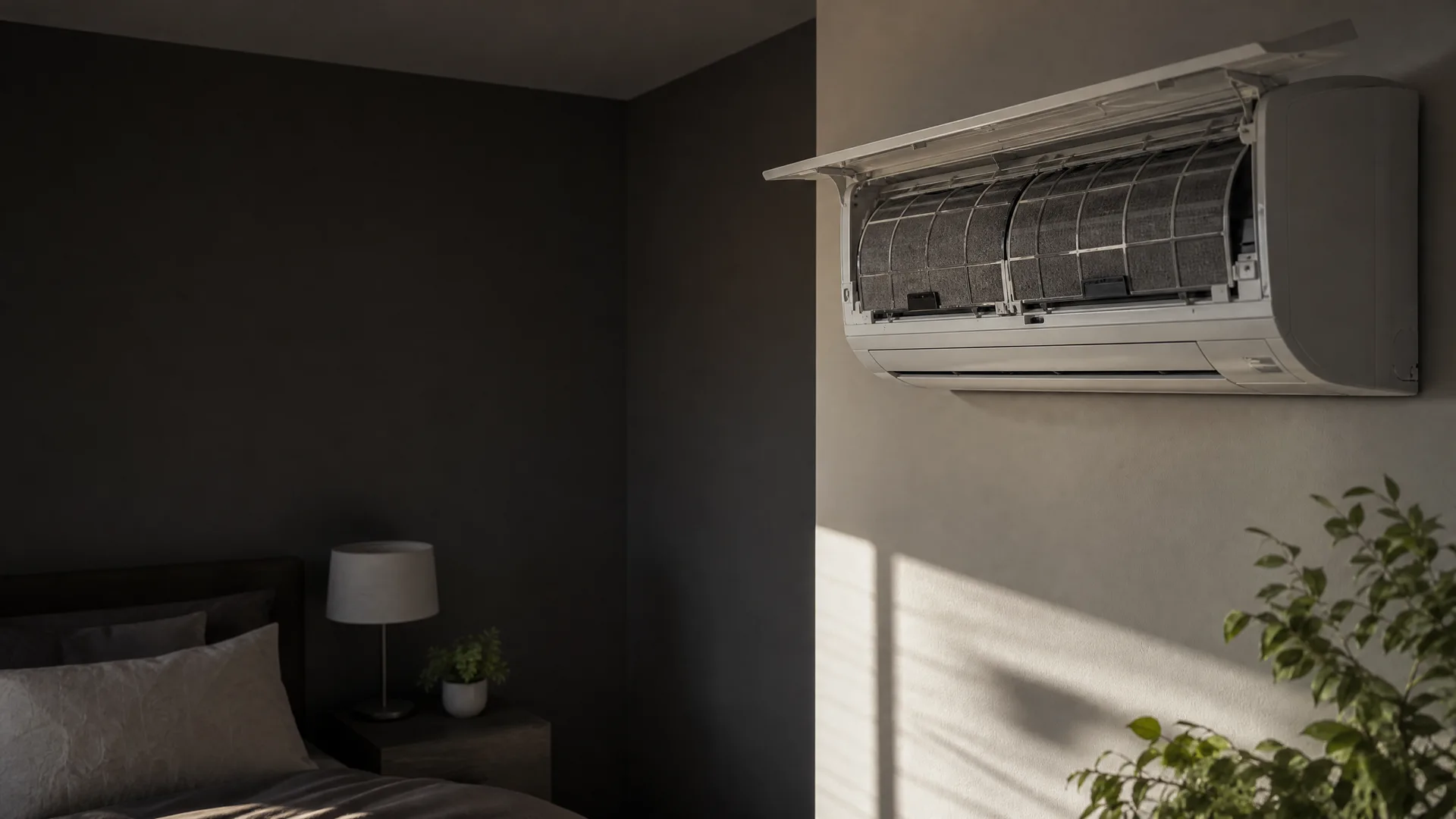
A wall-mounted mini-split air conditioner with its front cover open exposing the filters, in a dim bedroom with a bed, nightstand lamp and a potted plant.

You pull the cover off the indoor unit to wipe it down before the first warm week hits, and the filter screen stops you. It's gray with dust, matted enough that light barely comes through it. Pollen season just ended outside your window, and it shows. You press the filter back in, then pull it out again and look closer, wondering how long air has been dragging through that instead of past it. The bedroom still feels fine right now, the air still moves when you stand under the unit, but you make a note to get someone out before the heat really sets in and this thing has to run all day.

Stop chasing a mini split pro

A mini split working year round, through Louisiana summers and the cooler months in between, builds up grime in places you can't reach with a vacuum and a rag. That's what the tune-up handles. Finding someone to do it right is its own chore, though. You'd normally be pulling up names, calling a few, explaining the same thing about your system two or three times over, then sitting with quotes trying to guess who's worth the money. Send the request through this page instead and that part is done. One contractor gets it, not five, and you're not the one chasing anybody down. With how hard your unit works here, cooling most of the year and often covering the heat too, getting it serviced isn't something to put off long. Let the search for who does it be the part you don't have to deal with.

A mini split cools and heats off the same coil, so grime cuts both jobs at once. A dirty filter or coil this summer is a weak heat strike come January, not two separate problems.

That's why a tune-up timed before summer also sets you up for winter. One visit, one cleaning, and the unit has what it needs to move air hot or cold for the months ahead.

A wall-mounted mini-split air conditioner indoor unit with a dusty, discolored cover, installed near the ceiling on a plain light-colored wall.
Before you get your mini split maintenance
A white wall-mounted mini-split air conditioner unit installed high on a light gray interior wall below crown molding, with a bamboo-shaded window at the lower left.
After you get your mini split maintenance

Running it without a tune-up

Your mini split still cools and still heats, so it's easy to let a year pass without anyone looking at it. The filter keeps catching what it can until airflow drops off, and the indoor coil picks up the rest. You notice it as a system that runs longer to hit the same temperature, or a bedroom that stays warmer than the rest of the house. Nothing fails outright. It just asks for more from the compressor and the blower, month after month, to do what a clean unit does with less effort. By the time something does break, it's usually the part that was working hardest the whole time.


Having a technician look at it

A technician opens the unit, cleans what's collected on the coil and filter, checks the refrigerant charge, and clears the condensate drain before it backs up. The outdoor unit gets washed off too, so it can shed heat the way it's supposed to in July. None of this changes what the mini split does. It cools the same rooms and heats the same rooms through the same months. What changes is how much it has to work to get there, and whether the parts carrying that load are clean or caked when the hardest weeks of summer or the coldest nights of winter show up.

A gray-haired man with a beard in a blue button-placket shirt reclines on a couch with his eyes closed, beside a sunlit window with a green plant.
A woman in a cream knit sweater sits in an armchair with her eyes closed near a window showing yellow autumn foliage, with a mug on a round wooden side table beside her.
  1. The technician pulls the indoor unit's cover and filter first.

  2. The filter gets washed or swapped if it's torn.

  3. The indoor coil gets cleaned with a coil cleaner and soft brush.

  4. The blower wheel gets wiped down to remove caked dust.

Power costs 12.52 cents per kilowatt-hour statewide

Since your mini split runs on electricity for both cooling and heat, a dirty coil or clogged filter shows up straight on your bill, not just in comfort. At 12.52 cents a kilowatt-hour, a unit working harder to move the same air costs you more every month it goes unchecked.

EIA-861 2025 statewide residential average

A mini split tune-up in Louisiana covers the filter, the indoor coil, the blower wheel, the outdoor coil, and the condensate drain, cleaned and checked before the load of summer or the first cold snap hits. That's the whole answer. What it means for you is a unit that moves the air it was built to move, cools and heats off a clean coil instead of a dirty one, and drains the way it should instead of backing up into your wall. The part left is finding someone to do it. That's calling around, explaining what you've got and what it's doing, waiting on quotes, trying to tell which one knows a mini split from a regular split system. Send the form and that part is done. You're not left holding a list of numbers to dial, deciding who sounds right, or going through the same explanation three times. Someone qualified gets to you, and the unit gets looked at before the season that needs it most.

A curving paver walkway runs alongside a house with beige lap siding and a white-trimmed window, bordered by low shrubs, grassy plants, and trees in sunlight.
A dark-framed casement window with divided upper panes set in a stucco wall beside a stone-clad section, with hydrangeas, hostas and trimmed shrubs in a mulched bed above a lawn.
White horizontal lap siding wall with a single six-pane double-hung window, above a mulched bed of hydrangea shrubs with browning blooms, bordered by mown grass in low sunlight.
Interior corner with tan plaster walls, a potted olive tree in a large terracotta urn beside a floor-to-ceiling window, and a wooden bench with a beige cushion on a herringbone brick floor partly covered by a woven jute rug.
A wooden bench beneath a window holds a green linen cushion and a fringed cream throw, with a woven basket stored underneath on a wood plank floor.

Send one request and you're done looking

Skip calling around to set up a mini split tune-up.

Skip calling around

You're not committing to anything by asking.